
Good graphic novels tend to appear in bookstores seemingly out of nowhere after years of rumors, scattershot serialization, “process” zines and snippets posted to social media. As literature, long-form comics are uniquely resistant to editing. As visual art, the cartoonist is in the weird position of having no access to the final product until it’s presented to the public. So it’s frankly miraculous when we get as many good comics as we do. This year there were remarkable new books from established masters and freshman graphic novels from brilliant young artists. Better still, a gratifyingly thick stratum of our 2023 stack was devoted to making us laugh. It’s a rich conversation, and one that promises to continue into next year and long beyond.
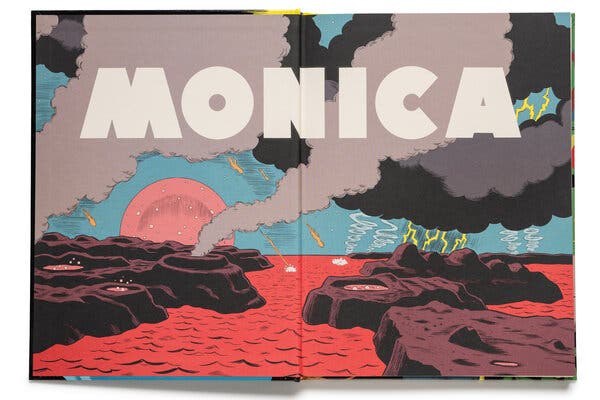
From the moment you open it, Daniel Clowes’s MONICA (Fantagraphics, 108 pp., $30) announces its ambition. Against the weird hellscape of its front endpapers, the title spread depicts the world at its lifeless, churning, brightly colored beginning. Then all of time (so far) goes by in a whoosh on the next two pages — the dinosaurs, Jesus, Hitler, Little Richard, Sputnik — alongside the copyright boilerplate and the names of the editors and publicist. In Clowes’s smooth lines and precise hues, the rest of the book borrows styles from war, horror and romance comics to tell the story of an ordinary woman trying to give her life some meaning. Is such a thing even possible? Could the attempt destroy everything?

The four bickering roommates in the cartoonist and stand-up comedian Benji Nate’s GIRL JUICE (Drawn & Quarterly, 176 pp., $24.95) annoy one another, but that doesn’t stop them from proclaiming undying sisterhood. The adventures of Nana, Bunny, Tula and Sadie make for both a joyous gag comic and a hilarious slow-burn graphic novel with plenty to reward repeat visits. The book ends with a very fun novella about a demon who helps give Tula’s YouTube career a lift, but my favorite joke is the way Nana begins dating a clown and slowly starts wearing ever-clownier outfits.
One of the great pleasures of serialized comics is watching the sure hand of a gifted artist guide the creation of a story over months or years, and the 14 years Sammy Harkham put into BLOOD OF THE VIRGIN (Pantheon, 295 pp., $30) show on every page. He might as well have drawn it in his own blood. The book follows two threads, one telling the story of our hero Seymour’s frantic efforts to get his low-budget horror film made, the second exploring Seymour’s huge and eccentric family. Each story line offers a riot of Harkham’s lovely caricatured faces, and each subtle caricature is different from all the others.
Emily Carroll turns a haunted house story back on its narrator in A GUEST IN THE HOUSE (First Second, 248 pp., $27.99), a work of both quotidian realist intimacy and utter madness. The contrast is enlivened by Carroll’s uncanny ability to shift between styles. Carroll is a horror artist par excellence, but this is the first time she has sought to give her work the form of a novelistic, contemporary horror story instead of the fairy tales she has often imbued with her trademark bloody grace; the change of setting makes that assured eccentricity much more frightening when it finally surfaces.
Eddie Campbell first decided to fake his death in 2006 with “The Fate of the Artist” (also included in this volume) and the results were wonderfully funny, so it makes sense that he’d do it again. THE SECOND FAKE DEATH OF EDDIE CAMPBELL (Top Shelf, 192 pp., $29.99) features a man living Campbell’s life and married to his spouse; that man may or may not be Campbell. The question is both intriguing and kind of moot, since Campbell’s proxy (or not?) is his own Duchampian invention, but the character has a lot of wit to impart about authenticity, simulacra and Covid-19. Whoever he is, the man claiming to be Eddie Campbell often finds himself out of doors and trouserless.
In THE GULL YETTIN (New York Review Comics, 216 pp., paperback, $19.95) Joe Kessler draws the wordless fable of a boy aided and sometimes thwarted by a monstrous shape-changing bird-creature; it’s one of the strangest comics I’ve ever read and also one of the most affecting. Kessler’s palette is alight with oranges and yellows, and he sequences his panels with deliberate simplicity, so every incident in his story becomes as bright and clear as he intends. But he also breaks out of his simple layouts for emphasis and effect, and every time he does so, the decision reminds you how beautiful the individual drawings are.