
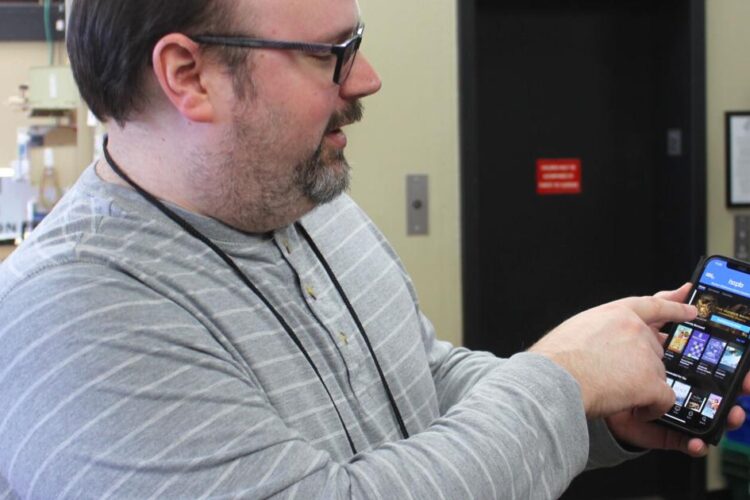

While many people have always enjoyed turning the pages of “physical” books, some have started to read e-books.
Jeremy Jones, branch manager for the Tahlequah Public Library, said e-books can be a convenient way to read, especially when traveling.
“I tend to read e-books when I take trips because I take a lot of books with me,” Jones said. “I used to take a suitcase full, but now I’ve kind of gone to the e-book route with that, [as] it is just so handy to have a device where you can choose what you want to read.”
The Tahlequah Public Library offers free options for e-book resources, with 930,167 e-books available. The apps – Hoopla and Libby – can be acquired by having a library card. Some resources, such as Libby, only allow the reader to check out five books at a time, but other apps, like Hoopla, have a rotating collection.
Jones said Libby and Hoopla feature fiction, popular nonfiction, mysteries, works from independent authors, and more. Even though e-books can be less expensive than physical copies, Jones said there is not as big of a price difference as there once was.
“Book publishing is still a very labor-intensive business,” Jones said. “They’ve automated a lot of it, but there are still a lot of people involved at the cost of the labor, which does drive up the cost of the print book. However, there’s a lot of promotion for the e-book, so that’s kind of added into the cost.”
Most e-books may cost less, but when it comes to textbooks, Jones said, the price is often the same.
While e-books and e-readers offer the convenience of having a person’s chosen material all in one area, Jones said they can also allow accommodations. For instance, the font size can be increased and narration elements can be added.
When it comes to research purposes, Jones said e-books allow for readers to search certain terms and topics.
“If you’re [reading] an e-book, like a nonfiction book, and you wonder ‘Where did they talk about that topic,’ or ‘Where was that recipe in that cookbook?’ you can search and it will take you to that section rather than having to flip or read through the book,” Jones said.
The age range for most e-books has mainly been adults, Jones said, but more kids are now wanting e-books. While their popularity has grown, Jones said, e-books do have their own set of struggles, with graphic novels and comic books being one.
Jones said when e-books first became popular, the entire page of a graphic novel would show up and the reader would have to manually zoom in and out of each panel. Now most graphic novels and comics are more accessible on some applications, as they automatically zoom in to each panel.
“There’s still a struggle with some graphic novels,” Jones said. “But everything is becoming a lot better, and a lot more intuitive. I think pretty soon there’s not going to be as much of a barrier.”