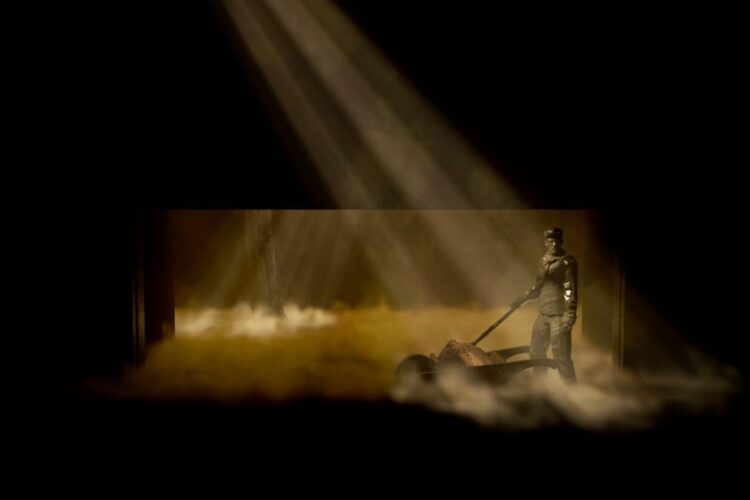
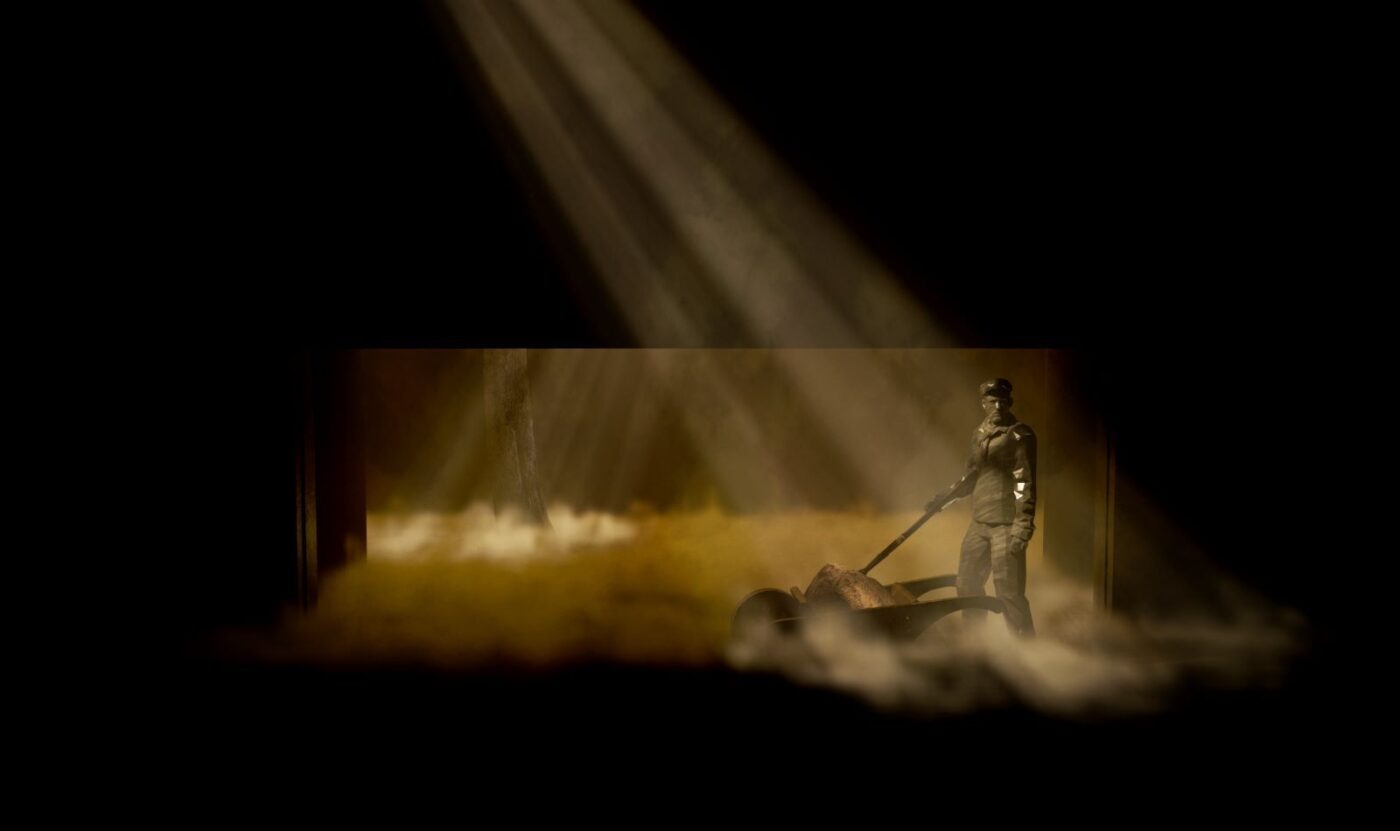
Set rendering by Dane Laffrey for Jen Silverman, Spain, 2023. Courtesy of Dane Laffrey and Second Stage Theater, New York City.
As an artist, Chris has the lens of an alien visitor to our planet. In college, his senior thesis involved scavenging for garbage, wrapping discarded Coke cans and debris in linen, affixing those wrappings to a large canvas, and painting over it. The results were otherworldly and inviting. As an eighteen-year-old, I looked at my brother’s work and I thought, Oh my god, you can do that? As an adult, whenever I see what he’s been making, I still think that.
Often when we visit our parents, I will take a train to Chris and then we will drive together. A direct trip would be two hours shorter, but I love our drives. When we are in the car, the rest of the world falls away, and we think out loud back and forth until the car stops. One of his most recent long-form projects is called #notesArt—a series of exquisite, detailed drawings that he makes in the Notes app of his iPhone, drawing with only his finger. He’s been posting one every day for the past year and a half, and an avid online following has developed. Recently, many of our conversations have been about this.
The conversation below is part of a phone call that took place at the end of my first week of rehearsals for my new play Spain (2023) at Second Stage Theater. By the time I got home, I was exhausted. I thought after our call, I would fall into bed. But talking to Chris made me excited. After we hung up, I kept wandering around my apartment, newly energized.
—Jen Silverman
Jen Silverman Bear with me. We’ve been talking about art and propaganda in rehearsal all week, so my brain is fried.
Chris Silverman Yeah, I’m in kind of a weird place myself. I don’t know, the situation in the Middle East—the news, and then being pissed off about how people are reacting to it—I haven’t been sleeping well.
JS And yet, the salvation is art! No, joking. What were you going to say?
CS You know, one of the hard limits that I put on myself for #notesArt was that I wasn’t going to include any politics. Partly because I don’t like arguing with people on the internet. I don’t think anything is accomplished by that. But also because there are really no sanctuaries from all the awful shit in the world right now, especially on social media. I wanted #notesArt to be apart from all that.
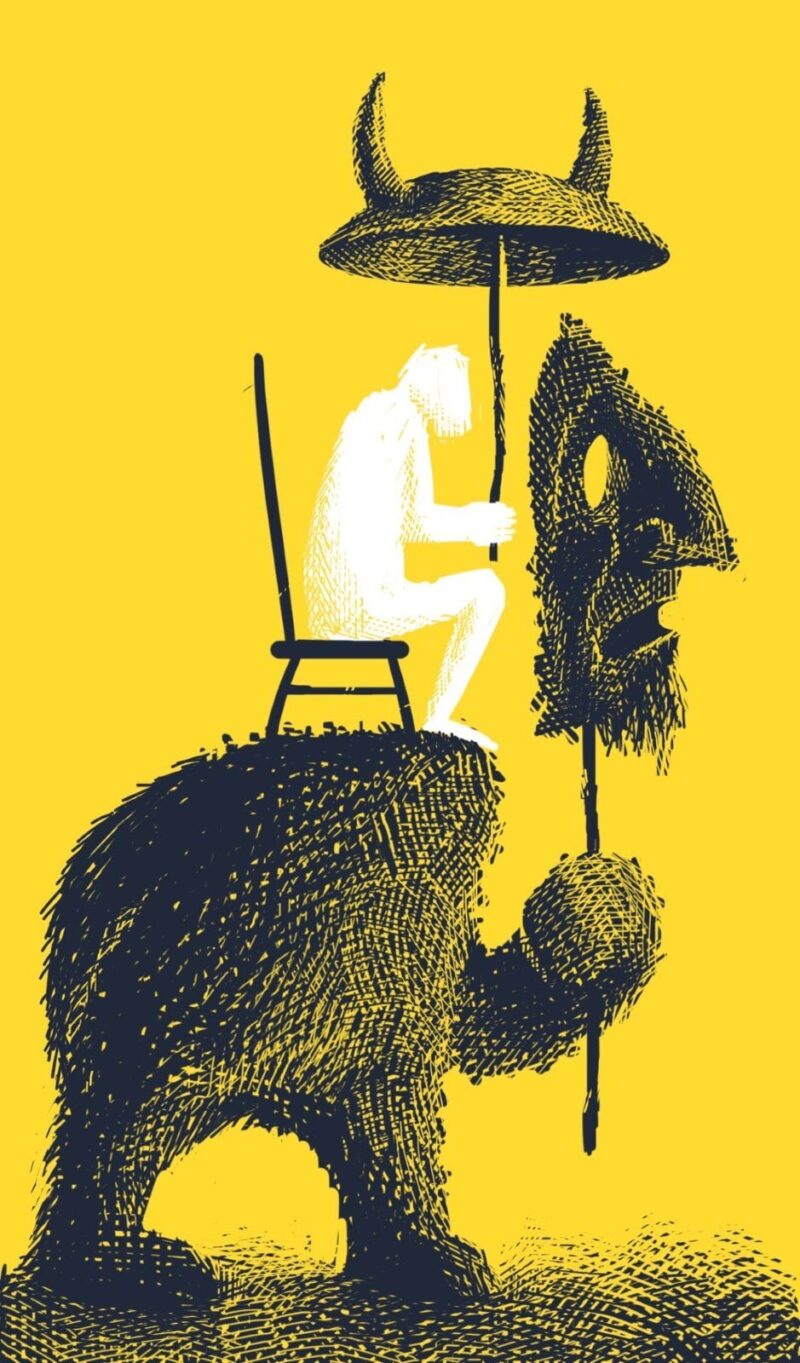
Chris Silverman, a piece from #notesArt, 2023. Notes app drawing on iPhone. Courtesy of the artist.
JS I see that in the way you use these bright candy colors that are so satisfying and inviting. Color as a refuge. Color as sanctuary.
CS Very much so. But right now I feel like I’m working under a limitation, like I can’t really express what I’m feeling. Whereas a lot of your work is unabashedly political. It seems like you’re never worried about saying controversial things.
JS You know, I was talking to my editor the other day about my new novel, There’s Going to Be Trouble. It takes place in 2018, in Paris, during the Yellow Vest protests, and then in 1968, in Boston, during the student protests. My editor was asking me to talk to my Random House team about when I came to consciousness as a political artist. And I realized, like, Oh, I don’t think about myself that way at all.
CS Don’t you?
JS Vaclav Havel is a political writer. My friend JT Rogers, who wrote Oslo (2017), writes plays that grapple with global politics in such a rigorous way. Whereas I feel like I’m just obsessively circling a set of questions: Is change actually possible on an individual level? On a communal level? If we are living under these legacies of violence and trauma, can we ever rewrite them? Or do we just keep handing them down, generation after generation?
When people call my work “political” and “feminist” and “queer,” I do see where that comes from. In my twenties, I used that language myself because it was an easy shorthand. At this point, it’s not wrong. It’s just not what I’m thinking about.
CS So for you the politics are kind of a backdrop? Almost like, you know, something set in a particular city, but the larger story is what the people do there?
JS Yes! We’re talking about this in rehearsal right now. Spain is set against the backdrop of the Spanish Civil War. Stalinist Russia funded an American documentary film that was a piece of propaganda. They hired Ernest Hemingway, and he didn’t even know he was working for them! A political apparatus is very present, but to me, the play is about how desperately we need to tell stories. Even when those stories get more and more corrupt, the storytelling instinct itself is so necessary to our happiness.
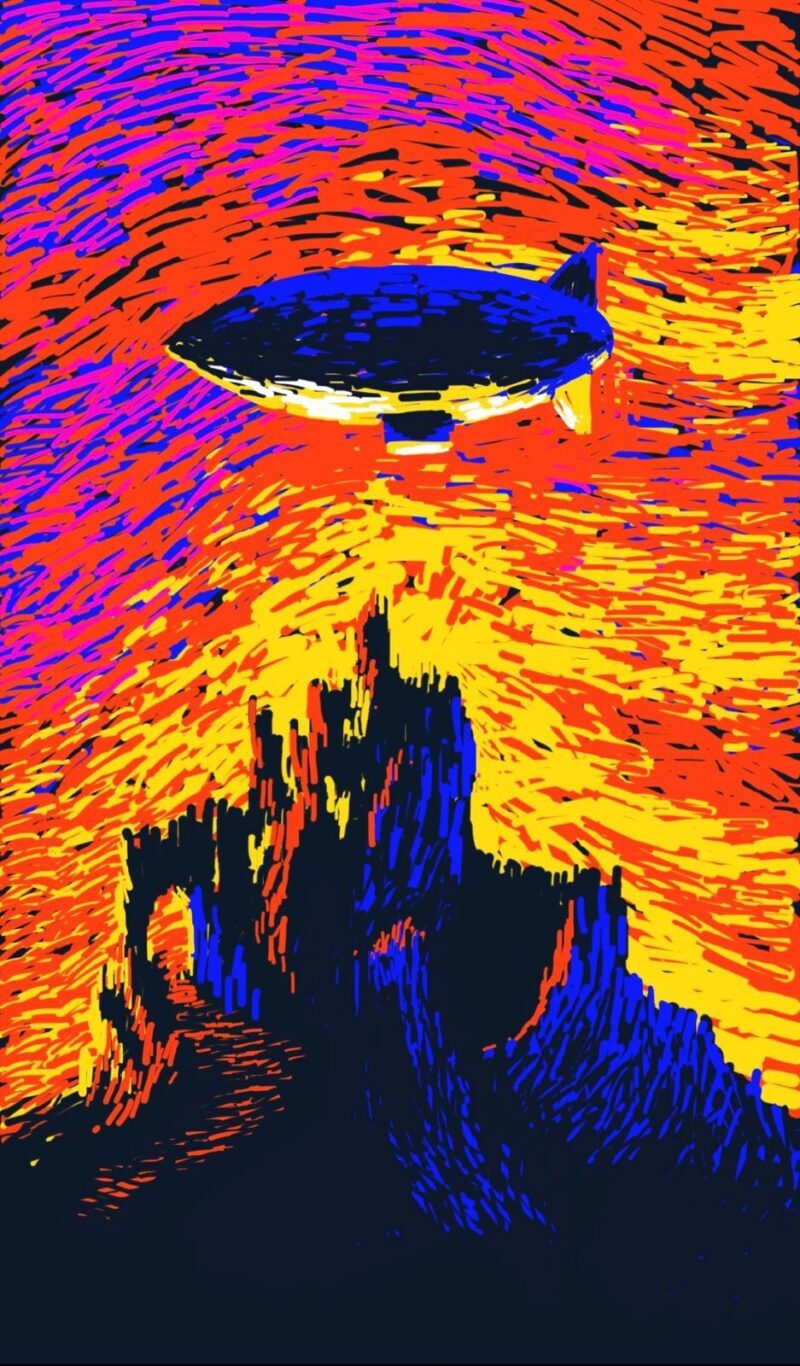
Chris Silverman, a piece from #notesArt, 2023. NotesApp drawing on iPhone. Courtesy of the artist.
CS What’s interesting is that whether or not you think of it as political, you’re writing about power and all these ways in which power can be exercised. I guess I see politics as the language of power. The structure through which power is exerted.
JS Weirdly, this is making me think about one of the photos you took. You were visiting me when I used to live in Washington Heights and we were walking together. All of a sudden, I turned around and you were kneeling on the sidewalk. You were taking a photo of this sticker that was stuck to the base of a lamppost.
CS Oh! That rat?
JS The rat! Everybody walked by that lamppost without even seeing it there. That photograph makes an unseen thing the center of the frame. Now, it hangs in my studio. And do you remember the series of photos you took in that public bathroom? You were photographing the soap bubbles on the underside of the dispenser. So much of your body of photographic work is about rendering the invisible not only visible, but the subject, the center. That’s shifting a power dynamic. Whenever I look at your photos, suddenly I have to ask, What else am I not noticing? Which I feel like is the most political question of all in some ways: What am I not seeing?
CS I guess it never occurred to me that that could be political. The politics that I’m used to are people shouting. You know, loud voices and loud opinions. Like we were saying about politics being the language of power, I think I avoid politics in art because I’m increasingly distrustful of power.
JS Shouting is politics devoid of power, because the minute you start shouting at me, I stop listening. Whereas your photographs quietly rewrite what’s worth seeing. And #notesArt upends the idea of what is required to make art. You’re just drawing with one finger in the Notes app on your phone.
CS I see a lot of preconceptions that keep people from even attempting art. Stuff like, Oh, I’m not smart enough; I’m not an artist. When it comes to digital art, it’s stuff like, Oh, I don’t know Photoshop. But I think devices like the iPhone really call that into question.
I guess I see #notesArt as part of this new era where commonplace technology acts as sort of a gateway drug to making art. So many people have smartphones. People take photos and videos more than anyone ever has before. They apply filters. That’s exercising some sense of aesthetics right there. With Apple’s Memoji feature, you can assemble a 3D self-portrait of yourself, or any character really. You don’t have to buy it, it’s there. There’s no extensive training. You don’t have to have a PhD or some artist statement about what you’re doing. You can just punch something together on a screen and share it, you know, with whoever has internet access.
Some people aren’t going to like me referring to this as art, but I think it’s arguable. These are creative acts that result in something specific to your tastes. You could argue that there’s something very political about the lack of power required—the sheer access, sheer accessibility.
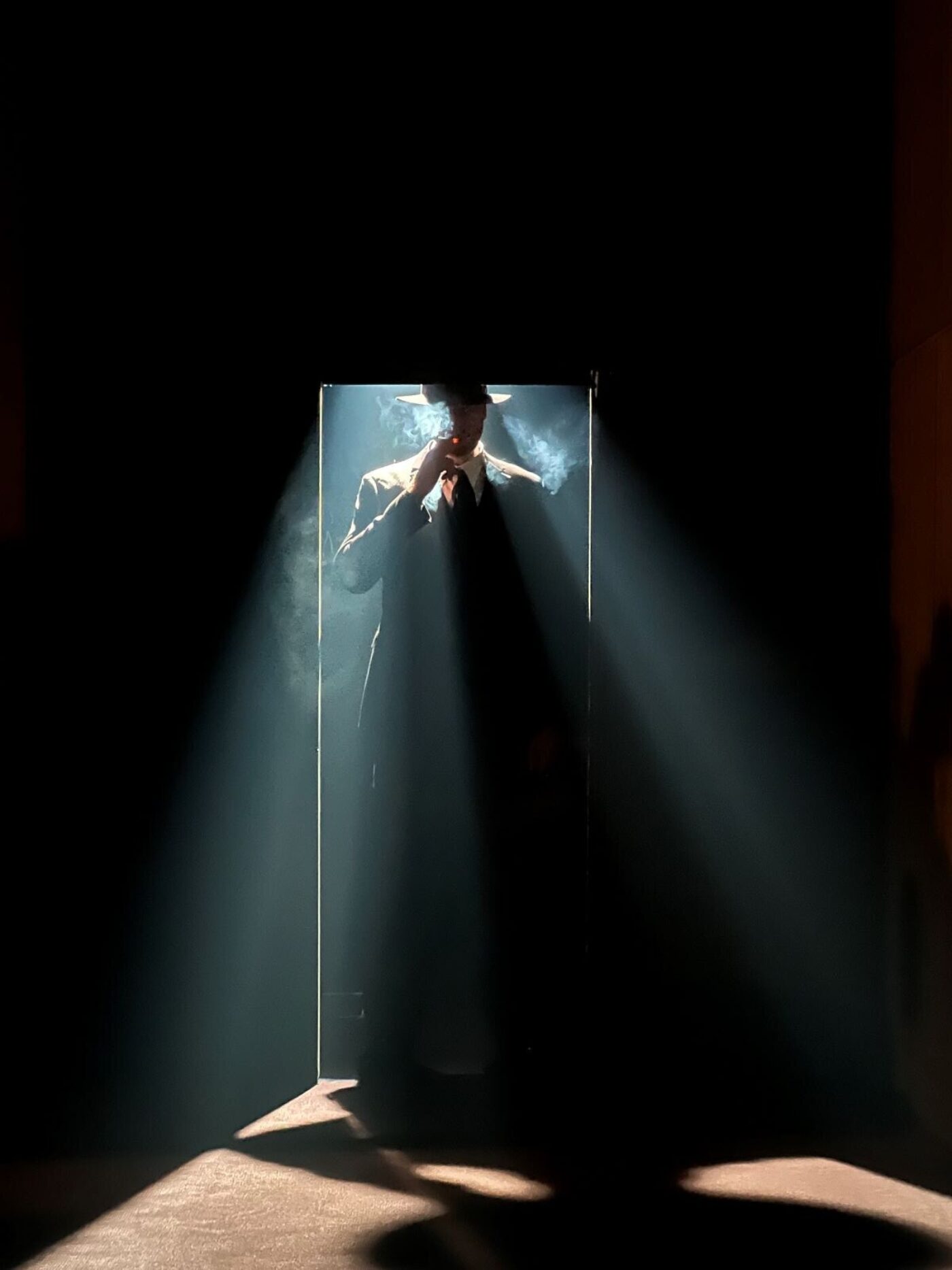
Rehearsal still from Jen Silverman, Spain, 2023. Zachary James pictured. Photo by Alejo Vietti.
JS In theater, I always want to feel like somebody is thinking out loud in front of me, not like I’m being presented with some tidy little nugget. And it feels like #notesArt started in this place of thinking out loud—like, What Happens If? I mean, there’s a whole other conversation about how art is tied to money in a country where there’s no arts funding. How trying to sell something is always at odds with the risk and mess of thinking out loud. Even acknowledging that reality, it makes me want risk and mess all the more.
CS I’m somewhat privileged, I would say, in that I don’t rely on art for my employment. I have a day job. If I were trying to make money as an artist, that would add a whole other level of having to worry about what other people think. You’re a working artist and I’ve always been kind of amazed that you didn’t seem to worry too much about what other people thought of your work.
JS Oh my god, I do! I’m not that cool and aloof! Once something is done, I’m not particularly fragile. I can engage with audiences. But if someone else’s voice is in my head when I’m writing, then there’s no way I can ask the questions I need to ask. Right now, with the work that I’m making, there is a very particular conversation I need to have to move forward. As a person, not just artistically. The way that I know how to have conversations like that is to put them on a stage, put them in a book, put them on a screen, have it in my body, have it with the artists who gather around the work to help make it. Have it all the way through to the end. Then, when I’ve done that, it’s like an exorcism of some kind. Now I can move forward.
CS What’s the conversation you’re having with Spain?
JS I wrote the first draft in early 2021. Theater was shut down. All of the systems that I had been working within were shut down. As were larger systems: American health care, the government. Every framework was crumbling. Every morning that I woke up, I was like, Get out of bed…Why? The answer became, Oh, because I’m reading a novel and I really want to get to the end. Or because I’m watching a movie. Or because I’m making a drawing.
I think the thing that I’m trying to say is that I had to write Spain because I had to ask myself: If all of my frameworks of understanding turn to dust, will art save my life? Ultimately, to me, it turns out the answer is Yes. Not in theory. Practically, concretely: Yes. I don’t know if people will watch the play and think, Yes. Who knows what Spain will be for them? But that conversation was the one I had to have.
Jen Silverman’s play Spain is running at Second Stage in New York City through December 17. Chris Silverman’s #notesArt series is currently in progress.