
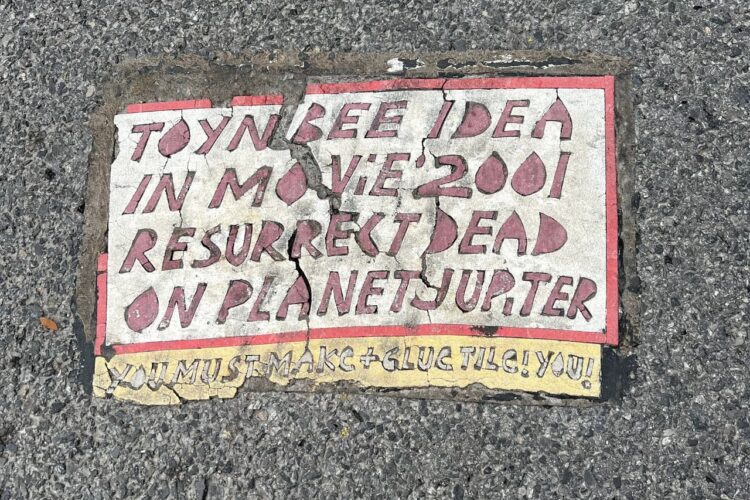
The next time you’re strolling downtown Syracuse, keep an eye on the asphalt. Chances are you may be stepping on a piece of art.
In July, at least nine mosaic tiles began mysteriously appearing on the streets of downtown.
They’re scattered on crosswalks or busy intersections. They were revealed piece by piece, aided by passing vehicles that slowly eroded the tar covering them. The emergence of these peculiar tiles raises a few questions: What do they mean? Who put them there? And why Syracuse?
Here’s what we know about Syracuse’s most mysterious new street art.
What are they?
The street tiles, originally known as Toynbee Tiles, are mosaics pressed into the road’s surface. The tiles are constructed from vinyl composition tile and linoleum. The mosaic is pre-made, then covered in a tar paper and placed on asphalt, said Bancks Holmes, a tile researcher who runs @tilewatch_phl on Instagram.
When the tiles are first pressed into the road, they’re hidden. Car traffic slowly pushes the mosaic into the asphalt and removes the concealing tar, revealing a colorful mosaic. Typically, the tiles are laid on late at night following a hot summer day, when the asphalt is warm and soft. It makes it easier for the tiles to integrate into the road. Almost all the tiles found downtown are visible by now.
Who makes them?
Each tile downtown is branded with “HOH23.” That’s the calling card for an artist known as House of Hades. Their identity is unknown, but Holmes said he believes the artist is from Buffalo and now based in New York City. Most of the tiles made by House of Hades can be found in the major cities along the East Coast, like New York, Boston, Cincinnati and Pittsburgh.
There’s evidence of House of Hades’ work in major cities as early as 2005. The artist was a copycat in the beginning, Holmes said.
The first Toynbee Tiles emerged in Philadelphia in the 1980s. The original tiler’s identity is also unknown. The tiles contained cryptic messages typically aimed at government or media.
Now, if you stumble upon a street tile, it’s probably from House of Hades. The artist has created a style distinct from the original tiler, but there’s an ideological consistency, said Holmes.
“I think that’s part of what motivated House of Hades to get started,” he said. “[House of Hades] read these tiles, not only was [House of Hades] like it’s a new, interesting medium, but also ‘I identify with this message.’”
While anti-establishment and anti-media ideologies can be seen as niche, the messaging from the original tiler and House of Hades resonates with people, Holmes said. Compared to the original, House of Hades tends to focus more on the arts aspect than messaging.
Most tiles found downtown don’t contain a message. They’re just mosaics. But the tile located on the intersection of South Warren Street and East Fayette Street contains the same message from one of the original Tonybee tiles:
“Toynbee idea in movie 2001 Resurrect Dead on planet Jupiter. You must make + glue tile! You!”
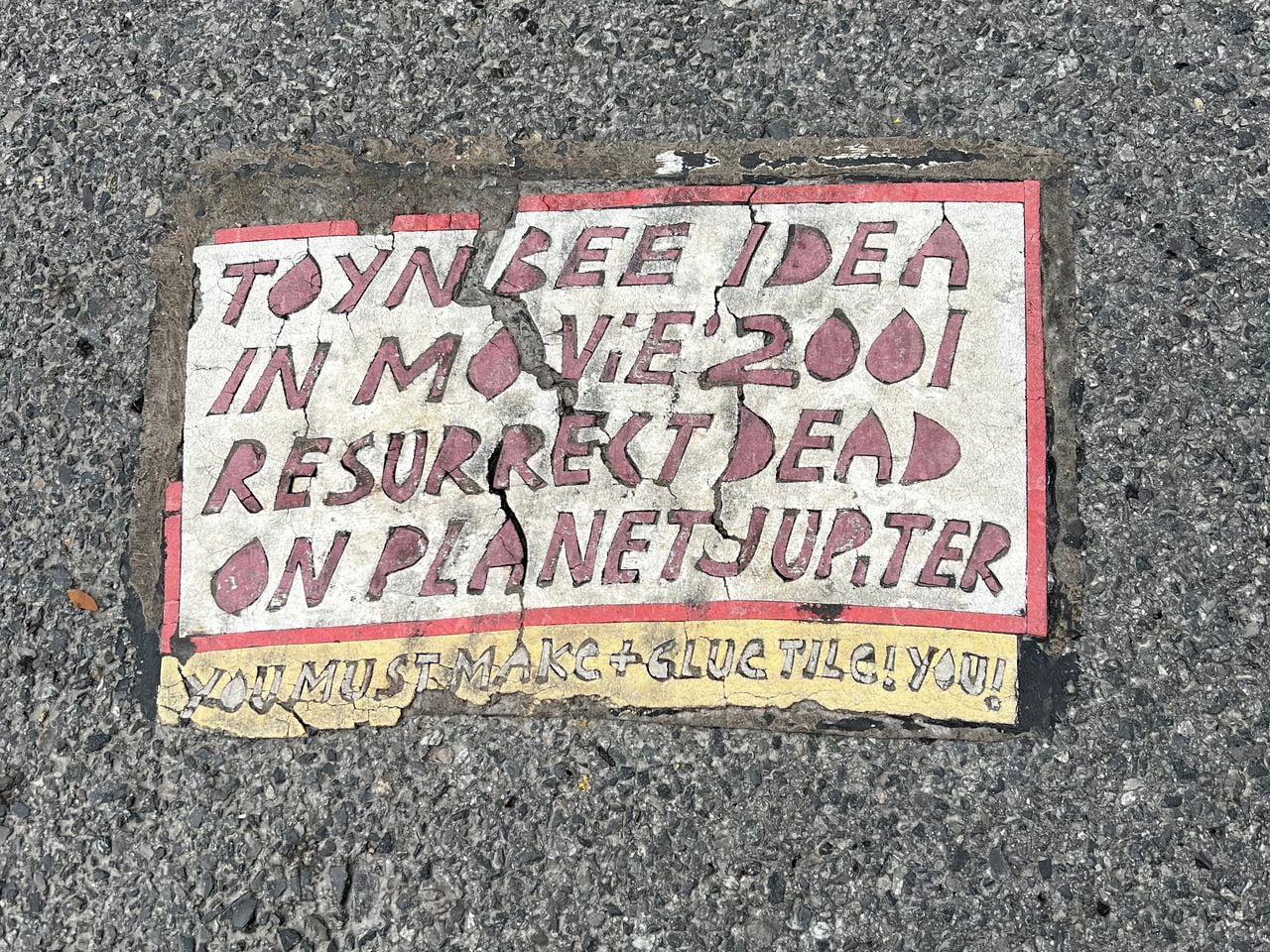
House of Hades tile found on the intersection of S. Warren Street and E. Fayette Street.Tania Ortiz
“Toynbee idea” refers to British historian and philosopher Arnold Toynbee, according to the 2011 documentary “Resurrect Dead: The Mystery of the Toynbee Tiles.”
Like Bansky, House of Hades likes to keep a low profile. The artist never stays in a city for too long.
Why Syracuse?
Despite House of Hades mostly doing ‘tile drops’ in major cities, Holmes is not surprised the artist stopped in Syracuse. The tile researcher keeps track of where the unidentifiable artist has left their mark. If the artist has connections in Buffalo and New York City, it makes sense that they came to Syracuse. It’s in between the two, he said.
Holmes had no idea House of Hades hit Syracuse, until local historian David Haas posted about the tiles. Haas, who runs the Syracuse History Instagram page, received a tip from someone who knows the artist about the tiles getting installed, he said.
Haas thinks it’s incredible these tiles have made their way to Syracuse. He hopes the community continues to build on these kinds of things.
“It just adds to the environment of art that we’re trying to build in this city,” he said. “Walkable cities are what I and others in this community are trying to create and having art on landscape for people to look at when they’re walking goes a long way.”
READ MORE
Those eyes watching you? They’re painted by Vacant, Syracuse’s notorious graffiti artist
Syracuse’s newest massive mural celebrates the ‘village within the city’
What’s a ‘dancing plague?’ New display in downtown Syracuse explores social contagion in modern era