
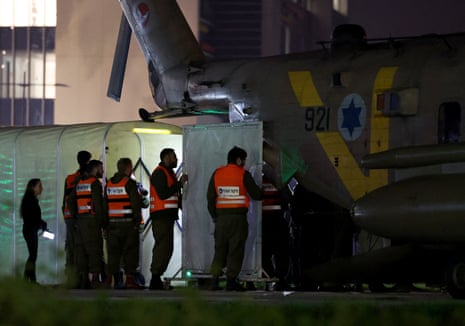
The Israel Defense Forces (IDF) have confirmed that the Israeli hostages freed from Gaza are now in Israel and have undergone medical checks.
A statement from the IDF reads:
The released hostages underwent an initial medical assessment inside Israeli territory. They will continue to be accompanied by IDF soldiers as they make their way to Israeli hospitals, where they will be reunited with their families.
Axios’ Barak Ravid has shared the full IDF statement in English:
Spain and Belgium’s prime ministers called for a “permanent ceasefire” on Friday at the Rafah border crossing, welcoming a four-day truce that paused fighting between Israel and Hamas.
“It is absolutely necessary to establish a lasting humanitarian ceasefire to reverse the catastrophic situation that the people of the [Gaza] Strip are going through,” said Spain’s prime minister, Pedro Sánchez.
Alexander De Croo, Belgium’s prime minister, echoed Sánchez, saying: “The destruction of Gaza is unacceptable. We cannot accept that a society is being destroyed the way it is being destroyed.”
Here’s the clip:
It’s midnight in Gaza City and Tel Aviv. Here’s a recap of the latest developments:
-
A total of 39 Palestinian prisoners were released by Israel on Friday evening. They consisted of 24 women, including some convicted of attempted murder for attacks on Israeli forces, and 15 teenagers jailed for offences such as throwing stones. Some had not seen their homes for many years. Celebrations have been taking place in the occupied West Bank following their release.
-
The hostage release came as part of a deal that has brought about a temporary pause in hostilities. The four-day ceasefire marks the first break in seven weeks of war in Gaza and offers some relief for the 2.3 million Palestinians who have endured intensive Israeli bombardment, as well as for families in Israel fearful for the fate of their loved ones taken captive during the attack that triggered the conflict.
-
Some 137 trucks of goods were offloaded by the UN agency for Palestinian refugees (UNRWA) reception point in the Gaza Strip on Friday. The UN office for the coordination of humanitarian affairs (OCHA) said it was “the biggest humanitarian convoy received” in Gaza since 7 October. In addition, 129,000 litres of fuel and four trucks of gas also crossed into Gaza, it said.
-
Under the agreement, Hamas is due to free at least 50 of the approximately 240 mostly Israeli hostages it has held since launching attacks into southern Israel on 7 October in which 1,200 people, mostly civilians, were killed. In return, Israel will release at least 150 Palestinian prisoners and allow up to 300 trucks of humanitarian aid into Gaza.
-
The Israeli offensive on Gaza has killed more than 14,000 people, thousands of them children, according to Palestinian officials. More are thought to be buried under rubble. At least 1,200 people, mostly civilians, were killed in the Hamas attacks on 7 October, and more than 240 people taken hostage.
-
Joe Biden said Friday’s hostage release was the “start of a process”, adding that he “will not stop” until all remaining hostages in Gaza are brought home. In a statement, the US president said the deal reached by Israel and Hamas involved “extensive US diplomacy”, adding: “It’s only a start, but so far it’s gone well.”
Israel has received a list of hostages who are expected to be released by Hamas on Saturday, according to Benjamin Netanyahu’s office.
Netanyahu’s office said it has notified the families whose loved ones are set for release.
Helicopters carrying released hostages have arrived at several hospitals across Israel where they will be reunited privately with their families.


The head of the World Health Organization (WHO) has described the release of hostages as “welcome news and an enormous relief”.
Posting to social media, Tedros Adhanom Ghebreyesus said he hoped all remaining hostages will be soon be released and reunited with their loved ones. He added:
While still in captivity, they must have access to any medical care needed.
In the heart of Tel Aviv, several hundred people waited in the plaza now called Hostages Square.
As darkness fell the mood was melancholic but hopeful as people waited for a confirmation that 13 women and children held by Hamas had been freed as planned.
Then came a cheer as news of their release was confirmed.
People sang Shabbat or old folklore songs as they waited outside the Museum of Art, where among the most poignant displays was an empty dinner table, surrounded by 240 empty seats, representing each of the missing hostages, not just the handful in the slow process of coming home.
“I’m just looking at these pictures and seeing that Israeli children and women and whoever are coming back to their families. I mean, it’s amazing for us,” Gil Dickmann told the BBC, even though his cousin Carmel Gat was not going to be one of those released in the first wave.

Celebrations broke out in parts of the West Bank after a truce mediated by Qatar between Israel and Hamas led to the freeing of Palestinian prisoners from Israeli jails.
Here’s a clip:
The World Health Organization has released the following statement on the joint UN missing transfers of critical patients from al-Shifa hospital earlier this week amid Israeli bombardment:
“On 22 November, in cooperation with the Palestine Red Crescent Society, WHO participated in another joint-UN mission to transfer 151 patients, relatives and health workers accompanying them from Al-Shifa hospital in northern Gaza. The mission was undertaken following specific requests from health authorities and hospital officials in Gaza …
During this mission, the team transferred 73 severely ill or injured patients, including 18 dialysis patients; 26 patients with serious spinal injuries; 8 patients with severe chronic conditions; two in need of critical care; and 19 patients in wheelchairs. The patients were transported in 14 ambulances supplied and staffed by the Palestine Red Crescent Society, and two buses, with 8 health workers and 70 family members accompanying them …
It took 20 hours for the team to complete the evacuation, including 6 hours at a checkpoint where the team and patients were screened by the Israeli Defense Force. This was despite an initial agreement to only screen participants at the origination point in Al-Shifa Hospital.
The screening process involved checks on the patients, their relatives, and the personnel; these included elderly, children and severely ill patients. Three medical personnel from the Palestine Red Crescent Society and three from the Ministry of Health were detained.
After 6 hours at the security checkpoint, the convoy proceeded as the condition of some of patients was already deteriorating. Patients reached their final destination late at night.
Most of the patients were ultimately transferred to the European Gaza Hospital, with the dialysis patients admitted to Al Najjar Hospital. Both facilities are in the south of Gaza.
WHO is extremely concerned about the safety of the estimated 100 patients and health workers remaining at Al-Shifa. Due to the limited time that the mission members were able to spend in the hospital and the urgency of moving the most critical, it was difficult to determine exactly how many remain.
Two of the six detained health workers have reportedly been released. We do not have information about the well-being of the four remaining health staff, including the director of Al-Shifa hospital. WHO calls for their legal and human rights to be fully observed during their detention.”
French president Emmanuel Macron has welcomed the release of the first group of hostages.
In a post on X, Macron said:
“We remain mobilized alongside the mediators to secure the release of all hostages. Special thoughts go to the French hostages and their families. They can count on our determination.”
In a separate statement, the French foreign ministry said that the French government remains “mobilized for the release of French hostages within the framework of the agreement currently being implemented … and we are working tirelessly to obtain that,” Agence France-Presse reports.
Here is video of what appears to be the moment that Hamas handed over the hostages to the International Committee of the Red Cross earlier today:
The International Committee of the Red Cross (ICRC) has released a statement confirming its successful facilitation of the release of 33 Palestinian detainees from Ofer prison in the West Bank.
Posting on X, the ICRC said:
We have now successfully facilitated the release of 33 Palestinian detainees from Ofer prison to Ramallah. We have managed to do so thanks to our neutral intermediary role.