The panel featured 2023 3D/Interactive award winner Sarah Selby and shortlister Max Colson, BCS Futures Award shortlister Adam Cole, and Student Award winner Yuqian Sun. Georgia Smith reports.
3D/Interactive Award Winner: Between the Lines, Sarah Selby
Selby’s Between the Lines ‘seeks to highlight the human experiences behind the numbers and statistics, raising public awareness of the dehumanising nature of the border regime and creating a sense of shared responsibility.’
The use of unregulated AI and automated decision-making algorithms, which reduce individuals to numbers on a page, is on the rise in the UK border regime.
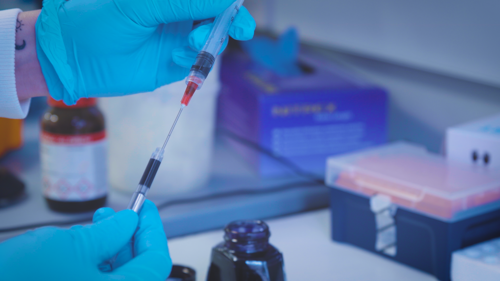
Between the Lines combines the traditional administrative tools of pen and paper with cutting-edge DNA data storage technology to centre the importance of individual experiences. During the project, text documents of written individual experiences were converted into binary data, which was then encoded into synthetic DNA, mixed with writing ink, and injected into pens which were distributed to frontline administrative workers of the UK border regime. Recipients were asked to register their pen via QR codes and sign a form acknowledging the heavy responsibility of their role. The act of writing with the pens transfers the synthetic DNA to the paper, spreading the individuals’ experiences throughout the foundations of the system that governs them.

BCS Futures Award Shortlist: Kiss/Crash, Adam Cole
Kiss/Crash is a triptych exploring the relationship between artificial imagery and human experience, focusing on intimacy in the digital age. Adam’s presentation focuses on the central audio-visual piece Kiss/Crash, in which a car crash turns repeatedly into a romantic kiss which becomes more intense with every collision. Kiss/Crash uses this classic Hollywood image of the cinematic kiss to reflect on the nature of artificial images and their homogenisation of our deepest desires, situating AI within the history of image production technologies and pinpointing its potential to accelerate the continued distortion of our intimate experiences through artificial lenses.
Adam’s installation also features the interactive ‘Crash Me, Gently’, which consists of a looping kiss on a television screen with a foot pedal which accelerates the intensity of the kiss — as the kiss progresses, it becomes more passionate, but simultaneously increasingly violent and pornographic. Adam found that when people interacted with the artwork, the insatiable desire to continue engaging with content pushed them to keep pressing the pedal even as the imagery became less enjoyable, adding an interesting extra layer to his commentary on our relationship with content creation and consumption.

Student Award Winner: Hyborg Agency, Yuqian Sun
In a spell of what one might almost call nostalgia, Yuqian joined us via Zoom. Her project Hyborg Agency integrates a digital forest with a human Discord chat channel, enabling communication between humans and AI deer or ‘hyborgs’ (a blend of ‘hybrid’ and ‘cyborg’). The ‘hyborgs’, which use ChatGPT to learn and grow, possess the capacity for both memory and curiosity and the conversations and knowledge they assimilate are conceptualised as the soil which further nourishes the growth of their virtual forest.
The piece reflects on the idea that current LLMs are primarily trained on public datasets while lacking access to closed conversations, which leaves AI missing information on how to behave socially; Hyborg Agency explores whether creating conversational communication between human and non-human agents can transform them into successful social members.

3D/Interactive Award Shortlist: Offshore Capital, Max Colson
Pursuing his interest in documenting the changes in London’s built environment and its unique manifestations of hidden but extreme wealth, since 2019 Max Colson has been working on Offshore Capital, making 3D scans of the city’s web of offshore-owned properties.
The project was specifically inspired by Private Eye’s research into London properties owned by offshore, tax-haven based companies; he wanted to create a project with this information but found it was difficult to capture interesting photographs of the properties from street level. He discovered LIDAR, which creates 3D images by triangulating millions of laser beams fired at objects. The results are visually interesting, but they aren’t without their limitations; LIDAR cannot penetrate hard walls, is low resolution, and is curtailed by a 20m scan radius. For Max, however, this is part of its appeal, as it captures the ‘ephemerality’ and inaccessibility of these properties as seen from public spaces.
Max publishes the LIDAR maps alongside images, videos, and property purchase information on a public website; the project aims to rectify the inaccessibility of information on where offshore property is and who owns it. He hopes to expand the project throughout the British Isles.

Panel discussion
The panel discussion centred around key themes related to the artists’ work, the first of which was ‘extraction’.
Max expanded on his interest in how technology transgresses the boundaries between public and private space, citing how Google street cars scanned private networks while mapping; he sees his work as an exploration of the ‘grey area’ of public and private information. Adam focused on the inherent element of extraction within generative AI, highlighting the gap between reality and artificial representations of human experience, especially as a queer person, and commented on how the interactivity of content consumption obscures that dissonance by making us complicit in its artificiality.