
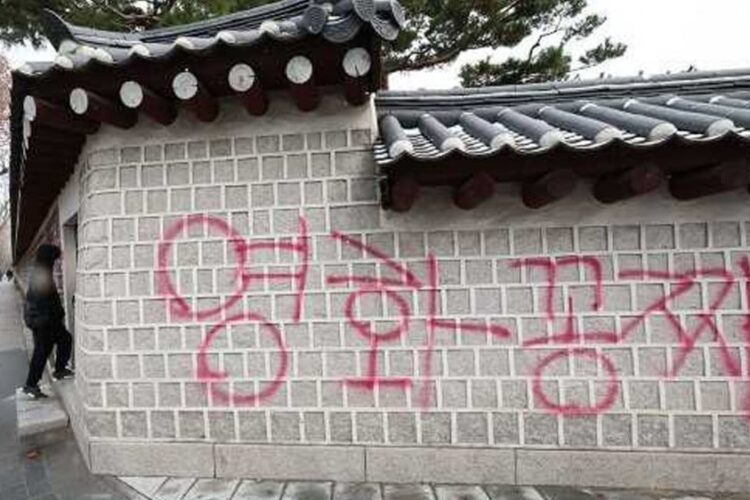
Seoul Court Rules Against Arrest of Teen in Palace Graffiti Case

Amid the placid surroundings of Seoul’s historic Gyeongbok Palace, a court has waded into the contentious waters of juvenile justice. On Friday, the Seoul Central District Court made a decision that spotlighted the delicate balance between punitive measures and the principle of juvenile protection. It denied an arrest warrant for a 17-year-old boy, surname Im, suspected of defacing a treasured cultural monument with graffiti. This judicial restraint underscores a broader question of how societies should respond to the missteps of their youngest members.
The cultural significance of Gyeongbok Palace cannot be overstated. It stands as a symbol of South Korea’s storied past, drawing tourists and history enthusiasts alike. The defilement of such a site, hence, provoked a swift police response. Im was apprehended at his home in Suwon after he allegedly spray-painted the phrase “free movie” across the western gate and the surrounding palace walls, an act that falls under the violation of the Cultural Heritage Protection Act.
During interrogation, Im’s confession unveiled a worrying trend of online manipulation. He claimed his actions were spurred by an anonymous social media entity promising remuneration for the unlawful deed. This revelation pivots the investigation towards the unidentified provocateur, as the police aim to prevent future incidents of this nature and safeguard Korea’s historic sites.
Marking a contrast, the court’s stance differed for a copycat crime. A man in his 20s, identified only as Mr. Seol, received an arrest warrant for similar acts of graffiti on the palace walls. The details of Seol’s defacement involved the promotion of a singer and their album, hinting at a possibly imitative motive. This distinction between the cases of Im and Seol brings to light the judicial system’s approach to age and criminal responsibility.
Chief Judge Lee emphasized the gravity of the crime against cultural heritage but pointed out that considering Im’s age, residence stability, and admission of guilt, an arrest warrant was deemed unnecessary. The decision takes into account the broader implications of incarcerating a minor, navigating the complexities of deterring crime while offering a chance at rehabilitation.
Should the investigation confirm their involvement, both Im and Seol could face severe legal consequences. The law does not look kindly upon damage to cultural property, with penalties that could include imprisonment for three years or more. Furthermore, Im’s parents might also bear the financial burden of restoration, given their son’s status as a minor.
The case against Im and Seol brings to the fore critical issues around cultural preservation, juvenile justice, and the influence of social media on impressionable minds. It serves as a stark reminder that the protection of national heritage is not solely the responsibility of the state but a collective societal duty. As the inquiry proceeds, the eyes of the public remain fixed on how this balance will be struck, reflecting on the values that shape the response to youth delinquency in a modern, digital age.