
Posted on December 3, 2023
Posted by John Scalzi
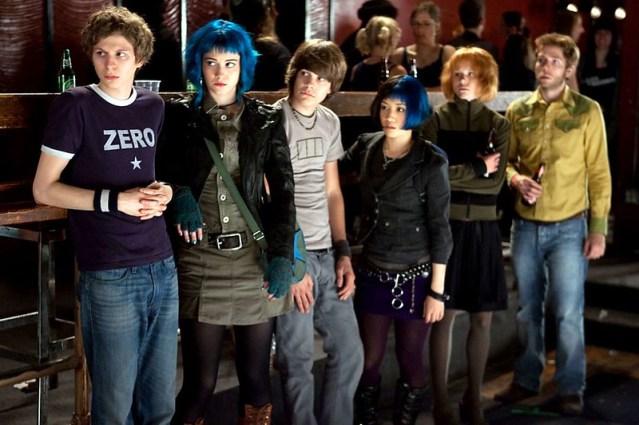
The first thing to know about this film is that the protagonist, the 22-year-old Scott Pilgrim, starts off the film as an actual and verifiably shitty person. Does he know it? Really, not at all, partly because he’s 22 and that’s not a quality age for self-introspection, despite being a quality age for self-absorption. His friends are no help because they are also in that age group; only two of them — notably, both women — bother to let him know he’s trash. He absolutely unsurprisingly chooses not to acknowledge their pronouncements.
This would be the part where a movie marketing person might say that Scott Pilgrim Vs. the World is the story of Scott going from a shitty person to a good person. This would be incorrect. When the movie ends, Scott is not a good person. He is, however, a better person, with the potential to be good person somewhere down the road, probably in his mid-thirties or something, which in my experience is the time of life where the “decent human or awful shitbowl” question is finally sorted out and you go through the rest of your life being one or the other. You can still change in your 40 or 50s or whatever, but something like 99% of us don’t. If you’re an awful shitbowl at 36, you’ve committed to the bit in the way you probably hadn’t yet at 22. It’s a long way back from there.
Scott Pilgrim still being obviously a work in progress at the end of the movie (implied extremely heavily by the last images before we cut to the credits) is one of the reasons I love this film. It’s easy to miss it in all the surface anarchy, clever humorous bits and videogame and comic book callouts, but in this matter — and kind of in this matter only — it’s one of the more realistic films about being in one’s early 20s, being full of inertia and yourself, and figuring out that maybe you can improve on yourself, if for no other reason than to be the person who still has a partner and friends five years down the road.
Which is not to say I don’t also enjoy the surface anarchy, clever humorous bits and videogame and comic book callouts . I certainly do. In fact, this is the first film by director Edgar Wright that I can say I really connected with. Wright was already beloved in comedy nerd circles for films like Shaun of the Dead and Hot Fuzz (both featuring Simon Pegg and Nick Frost), and while those films worked just fine for me, they weren’t ones that hugely moved my needle in terms of needing to seek out everything Edgar Wright did. Wright was clever! Clever is good! (Well, mostly.) But it took this source material to get me to see that what Wright was doing also could punch you in the face with a narrative. All the absurdity and chaos works, because, let’s face it, one’s early 20s are mostly absurdity and chaos anyway.
Everyone is a mess in this film. Scott’s a mess, as mentioned before, and Michael Cera does a very fine job personifying that mess, but he is hardly alone. Ramona Flowers (Mary Elizabeth Winstead, perfect casting), with whom he falls in love, thus precipitating the narrative crisis that drives the film, is no less a mess than Scott. She’s just a different mess — and tellingly, she’s well aware of the fact she’s a mess, even if she has no idea how to stop being a mess, except by running away, which I shouldn’t have to tell you doesn’t stop you from being a mess, it just means you have more time alone with your messy thoughts. I’ve seen Ramona Flowers categorized as a “manic pixie dreamgirl,” but that’s two-thirds wrong. Scott does see her in dreams, so fair call there, but in the film at least she’s not a pixie, and she’s definitely not manic; she’s Daria with curves. She’s a work in progress too.
So are Scott’s friends, and so are the people he fights for Ramona’s affections, and so are even the bit characters in the film. Everything in the film is heightened and funnier than it is in real life, and also, anyone who was ever in their early 20s probably had an “oh shit I did that” moment of recognition watching the characters in this film. We were all a mess! Hopefully less so now! But even so! I have affection for nearly everyone in this film, even six of the seven “evil exes” Scott is obliged to battle, because all of them are clearly having a struggle I understand or at least can empathize with.
(Jason Schwartzman’s character, on the other hand, can go fuck himself. But then he is clearly meant to be older than the rest of the characters, and has enthusiastically self-sorted into the “shitbowl” category, so).
The other thing that rings for me in this movie is how very specifically run down and spare everything about it is, not because the film is cheap (it cost $60 million, which for its own financial well-being was probably $30 million too many; it was a bit of a flop on release), but because when you’re in your early 20s and you don’t have anything approaching a livable amount of money to your name, you decorate in Dorm Room Cast Off style, your clothes are Goodwill Whatever, and you subsist off pizza and air. When you’re in your early 20s, this is fine! Try not to be caught doing it after 28. I certainly remember living in that mode when I was in my early 20s, loitering in that summer between college and my first real job.
All of which is to say that despite the substantial and literally fantastic artifice of Scott Pilgrim Vs. the World, and aside the humor and style, what brings me back to it over and over is its accuracy of the mode of being in one’s early 20s, not quite knowing who you are, much less who you are meant to become, and flailing about until you figure at least some of it out. In Scott’s case, it helps that he has Ramona to focus his attention on.
It’s been 13 years since the movie came out, Scott would be 35 now. I hope he’s mostly figured himself out. I hope Ramona has, too. I know where I want both of them to sort out.
— JS