
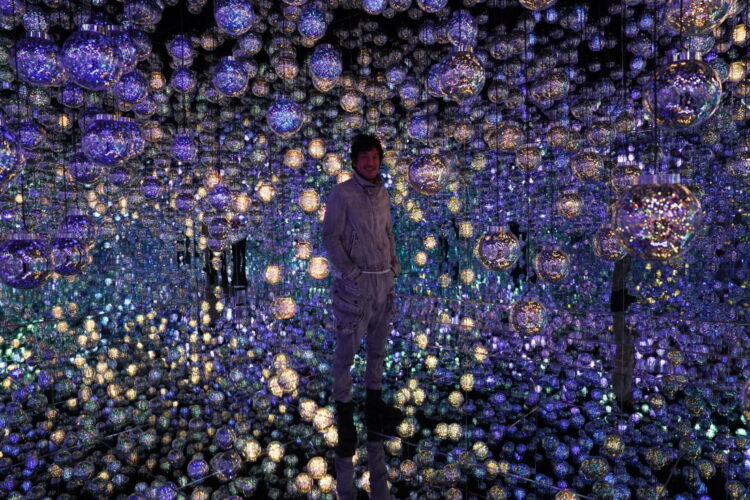
The scale of his ambitious installations, and the hundreds of projectors, sensors and other high-tech equipment involved, require space and funding not usually available to a struggling artist. It was Inoko’s biggest challenge in teamLab’s early days.
“What is created has to be a certain size. If it’s this size,” – he points to a water bottle on the table – “the body doesn’t really move. The [viewer’s] body needs to be able to freely move around the space. So we needed to find a large place to exhibit, we needed a certain number of projectors and displays, and back then we didn’t have enough money to do that. That was extremely difficult.”
Inoko started the collective with university friends Daisuke Sakai, Tetsuya Tamura and Joe Yoshimura, who remain with the group but keep a low profile. A fifth co-founder, Shunsuke Aoki, left in 2007 to start his own company. While Inoko is technically the boss, he is completely focused on the art and leaves the commercial side of the business to Sakai, who he met at a dance festival. Their gamble paid off.
TeamLab’s art is drawing millions of visitors a year to its museums where bookings must be made weeks, if not months, in advance. In 2019, its Borderless museum in Tokyo attracted 2.3 million visitors, according to teamLab property partner Mori.

Inoko’s new project leads a wave of immersive digital ventures that are booming as galleries seek new ways to attract crowds. Christopher Jue
The Japan National Tourism Organisation says one in 10 visitors to Tokyo go to its installations. TeamLab Borderless, which reopened in a new luxury mall operated by Mori on February 8, is the second permanent exhibition in Tokyo, with the existing teamLab Planets still a popular drawcard. A third major Japanese attraction operates out of a botanical garden in Osaka.
The installations have also gone global, appearing in physical spaces in New York, London, Paris, Singapore, Beijing and Taipei, not to mention garnering attention on social media. Outside Japan, there are large permanent exhibitions in Macau and Beijing, and more are planned in Abu Dhabi, Hamburg, Jeddah and Utrecht. It has become one of Japan’s most noteworthy cultural exports.
TeamLab made its first big splash in Australia in 2017 when an installation depicting weather “vortexes” and microclimates in cities was featured as part of the National Gallery of Victoria’s Triennial. It also has works in permanent collections in the Art Gallery of NSW and the Art Gallery of South Australia.
Inoko, exhausted from weeks of preparation, leans precariously back in his chair with his eyes half closed as he slowly contemplates answers to my questions. “Bed here, eat here,” he exclaims in English to demonstrate how his life has become the museum in recent months. Someone brings him a coffee during the interview, which is mostly conducted in Japanese through a translator.
Inoko is strikingly tall with a tousled mane of rock star black hair. He is wearing chunky boots and a matching denim jacket and pants, an outfit that contrasts with the tailored suits of the executives from teamLab’s sponsor companies. His weathered face offers more clues about his age, 46, than his demeanour, which is more of a restless musician.
I ask if he regards himself as a scientist or an artist. “I was interested in science and art from the beginning. As a child, I was more interested in science but the deeper you go into science, such as finding something smaller than an atom or larger than a universe, it becomes something further and further from your own existence,” he says.
“From a young age, it was not that I was interested in a specific artist but rather looking at how people looked at art historically through the ages. Why does the way people look at the world change so much?”
He was inspired by walks he took through a forest behind his primary school in Japan’s remote Tokushima prefecture. “It was a primeval forest, untouched, untainted. It is a forest that historically has never been influenced by people. I walked through it every day and all the life there exists with continuity, without boundaries. Nothing exists independently,” he says.
On those early walks through the forest and on family excursions where he was fascinated by a whirlpool in a local river, Inoko would take photos and videos of his surroundings. He became obsessed with the idea that the images taken through a lens constrained his experience of the natural world, creating “borders” in his perception. Was it possible to break down these barriers, and allow people to immerse themselves in a continuous experience rather than eyeing it from a single viewpoint?

Removing boundaries or borders is a concept that crops up repeatedly in teamLab’s work. Christopher Jue
The philosophy behind teamLab’s work is hard to get your head around at times, and Inoko spends a large part of the interview trying to explain it.
Removing boundaries or borders is a concept that crops up repeatedly in teamLab’s work, from the name of its latest exhibition, Borderless, to the artworks themselves which flow from room to room in the museum. This is achievable when you are not working with solid objects, but digital light.
With his foundation in science (he studied mathematical engineering and information physics at the University of Tokyo) and through collaboration with friends who were experts in mathematics and software development, Inoko was able to achieve his vision using interactive LED and projection mapping which turns objects into display surfaces for video projections. “From around 2008, we started creating something three-dimensional,” he says.
By 2011, teamLab’s work was gaining major recognition from galleries and artists. TeamLab Planets opened in Tokyo in 2018, giving it mainstream attention with more than two million visitors a year. Despite its origins, Inoko does not see teamLab as a “Japanese” company, preferring to emphasise it as a collective influenced by eastern art but staffed by people from all over the world.
Its financials are not public and the exact number of total employees, believed to be around 1000, is not clear. Executives shy away from discussions about the commercial aspects of what they call an art collective, or details of the technology behind the installations. A 2017 Harvard Business School case study into what it called an “ultra-technologist” group says profits are shared equally by employees and the private company has never had to borrow or raise external capital.
Inoko says he is focused on the art itself rather than the commercial machinations of the collective. It is an organisation where employees do not have titles, far removed from corporate Japan’s rigid hierarchical structures. That said, it is very much a business, with divisions dedicated to product and software development, and architecture and artworks for office and retail spaces, which is how it made money in the early days.
It is also leading a wave of immersive digital art projects, which appear to be booming as galleries scramble for new ways to make money and technology provides the means to satisfy visitors keen for “experiences” to share on TikTok or Instagram. There are immersive Van Gogh exhibitions in cities around the world. In Australia, the LUME Melbourne bills itself as the world’s largest digital art gallery. Meow Wolf’s Convergence Station in Denver and Culturespaces’ L’Atelier des Lumières in Paris offer similar experiences.
Perhaps because of their popular appeal, art world critics are unconvinced. Among them is art historian Janet Kraynak, who told The New Yorker in 2022 that museums were catering to mass appeal, which meant they were non-confrontational and less challenging or interesting.

Inoko says he is focused on the art itself rather than the commercial machinations of the collective. Christopher Jue
While some of the installations in the new teamLab Borderless will be familiar, much of the work is updated and there are new inclusions such as a room filled with jellyfish-like globes moving on tracks that light up when a viewer gets close. I am standing in what is perhaps teamLab’s most Instagrammed installation called Universe of Water Particles on a Rock where People Gather. A digital waterfall cascades over a boulder where children and adults climb and slide as they interact with a constantly changing tapestry of light and colour. Projections of white crows glide across the walls.
My guide, teamLab’s Sakurako Naka, shows me how to touch the walls to generate digital bursts of flowers, plants and clusters of butterflies. The floor is also a canvas; flowers bloom and then die where I am standing. On the other side of the room, a man runs around in circles creating a virtual whirlpool beneath his feet.
“People are always influencing the artwork and being influenced at the same time. All the people in the space all influence each other. That is why everything is always changing, it’s always different,” Naka explains.
Later, we drink tea in a dimly lit cafe inside the museum where a projection of blossoming flowers erupts in my glass bowl. At first, I assume the image is coming from a fixed projector in the ceiling, but when I randomly move the bowl, the flowers scatter and a new arrangement blooms inside. Like a stage magician protecting his tricks, no one at teamLab is willing to explain how the magic works.
In Tokyo on the morning after my interview with Inoko, teamLab Borderless opens to the public with a ribbon-cutting ceremony, which is widely covered by the Japanese media. Eager ticket-holders pour into the complex armed with mobile phones, ready to take the images that later bombard their social media feeds. They include many Australian tourists who have the museum at the top of their to-do lists.
Could this juggernaut come to Australia one day? Inoko is certainly keen. He talks enthusiastically about Australia’s unique landscapes, a recent drive along the Great Ocean Road and David Walsh’s MONA in Hobart. “For some reason I feel a kind of closeness to Australia. If there is an opportunity, I would love to exhibit in Australia,” he says.
When asked about his long-term vision for teamLab, his response is as convoluted and open to possibility as many of his answers have been in the 90 minutes we spend together. In short, he says his work is never done.
“As the world expands, it leads to discoveries that perhaps cannot be put into words. So based on that, I’ll make more [artworks] and once I’m done making that, it still won’t be done. And I’ll keep making and that will go on and on and then I’ll die.”
The April issue of AFR Magazine is out on Friday, February 23 inside The Australian Financial Review. Follow AFR Mag on Instagram.